
YouCubed Posters
Introduction
This term, we’re excited to share a series of YouCubed posters withyou. These posters are designed to inspire positive mathematical mindsets in children, encouraging curiosity, resilience, and a love of learning.
Every few weeks, we’ll post a new poster that highlights an important idea about how we can all grow as mathematicians.They’re simple, powerful reminders that maths is not just about right answers—it’s about thinking, exploring, and discovering.
We hope these posters spark conversations at home and help children see themselves as capable and creative problem-solvers.
Mrs Bradshaw 👱🏻♀️
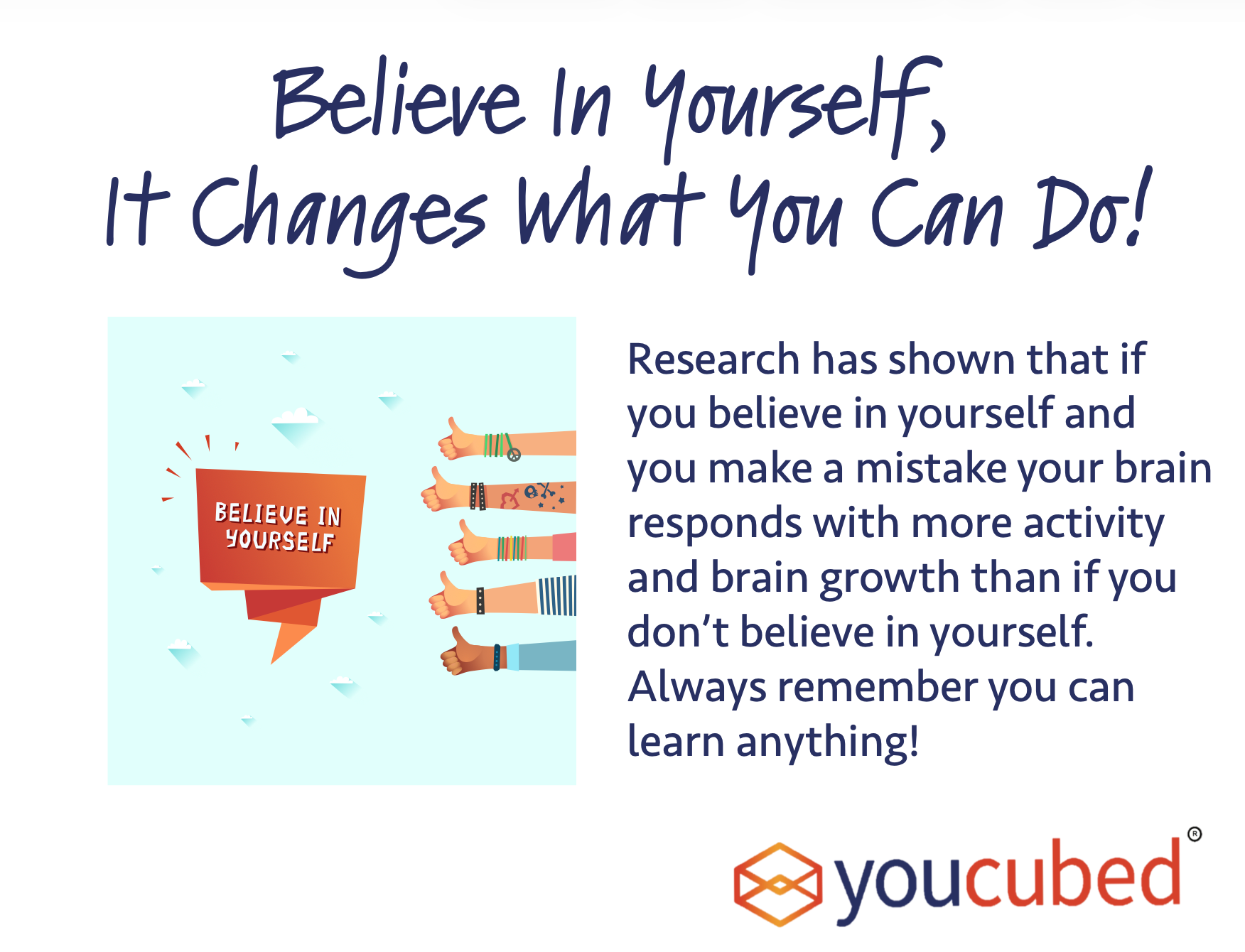
✨Our First Poster - Believe In Yourself, It Changes What You Can Do!✨
📣 This week, we introduced the very first poster in assembly:“Believe In Yourself, It Changes What You Can Do!”
The children heard how believing in themselves can make a hugedifference—not just in maths, but in everything they try. Over the next few weeks, we’ll be looking out for pupils who demonstrate this message by showing confidence, persistence, and a willingness to have a go, even when something feels tricky.
💡 Family Tip: When you share this poster at home, you might say:"This poster reminds us that believing in ourselves makes a bigdifference. Can you think of a time when you kept trying, even whenit was tricky, and surprised yourself with what you could do?"
We hope these posters spark conversations both in school and at home, helping children to see that confidence and effort really do change what’s possible.
✨Introducing Our Second Youcubed Poster: Everyone Can Learn Maths to High Levels!✨
We’re excited to share our second Youcubed poster with you. Its message is simple but powerful: there is no such thing as a “maths person.” Everybody can grow their maths brain, and learning maths is about building and strengthening pathways in the brain.
The poster shows three ways this growth happens:
🌱 New pathways form when children learn something brand new.
💪 Existing pathways strengthen when they practise and revisit ideas.
🔗 Different pathways connect when they see links between concepts, like noticing how fractions relate to division.
This means mistakes, practice, and connections are all part of the journey. Struggle isn’t a sign of weakness—it’s a sign of growth!
💡Ideas for Parents at Home
Here are some simple ways you can support this growth outside the classroom:
🧩 Celebrate mistakes: When your child makes an error, talk about what they learned from it. Remind them mistakes help the brain grow.
🎲 Play maths games: Board games, card games, or puzzles encourage problem‑solving and strengthen pathways.
🍎 Spot maths in everyday life: Cooking involves fractions and ratios, shopping uses addition and subtraction, and sports involve measurement and statistics.
🔄 Encourage multiple strategies: Ask, “Can you think of another way to solve it?” This helps connect different pathways.
🗣️ Talk about maths positively: Share your own curiosity, even if you find maths tricky. Children pick up on attitudes.
Why This Matters
When children believe they can grow their maths brains, they approach challenges with confidence. This poster is a reminder that maths success isn’t about being born with talent—it’s about effort, practice, and making connections.
Together, at school and at home, we can help every child see themselves as a capable mathematician.
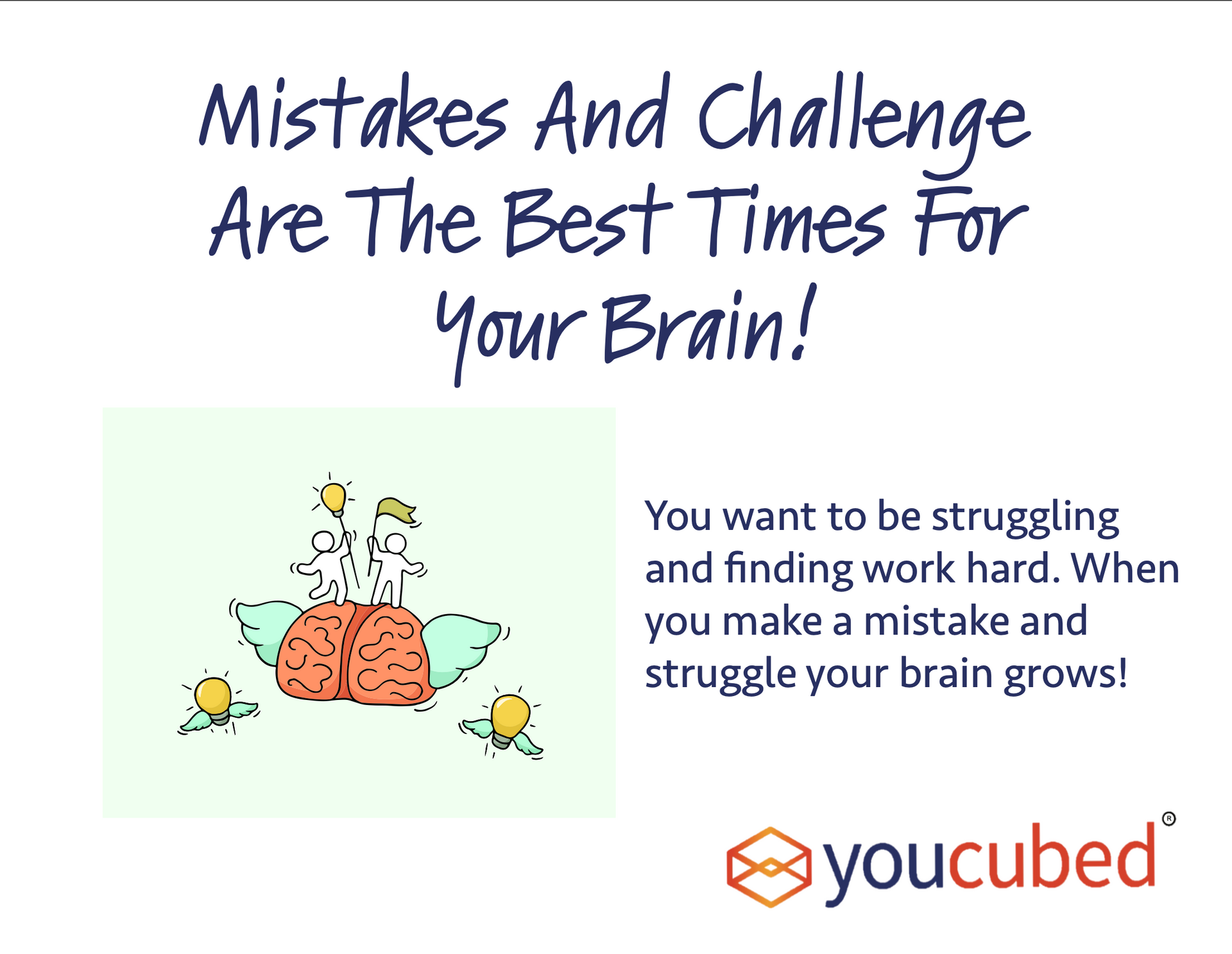
✨Introducing Our Third Youcubed Poster: Mistakes and Challenge Grow the Brain!✨
We’re excited to share our third Youcubed poster with you. This poster highlights a message we are reinforcing in the classroom every day:
Mistakes and challenges are the BEST times for your child’s brain!
When children make a mistake or find something difficult, their brains spark with activity. These moments create new connections and strengthen existing ones. Struggle isn’t a setback—it’s a sign of learning happening right there in the moment.
The poster reminds children that:
💡 Struggle is good — it means their brain is doing important work.
🧠 Mistakes help the brain grow — they activate brain pathways and deepen understanding.
🔍 Working hard builds resilience — sticking with a challenge helps children become flexible, confident thinkers.
This helps children see mistakes not as something to avoid, but as powerful opportunities to grow.
💡Ideas for Parents at Home
Here are some simple, practical ways you can help your child celebrate mistakes and embrace challenge outside the classroom:
🎉 Celebrate mistakes as learning opportunities
When a mistake happens, try saying:
- “Great! Your brain just grew!”
- “Mistakes help us learn—what can we try next?”
This shifts the focus from perfection to progress.
🧠 Talk about challenges positively
Share moments from your own day when something felt difficult. Children learn by seeing adults model persistence and problem‑solving.
🗣️ Encourage a growth-mindset vocabulary
Phrases like:
- “This is challenging because you’re learning something new.”
- “Let’s think about what this mistake is teaching us.”
These help children stay motivated during tough tasks.
🧩 Explore puzzles and problems together
Jigsaws, strategy games, and brain teasers naturally build resilience and show that challenges can be enjoyable.
🔄 Focus on strategies, not speed
Ask questions such as:
- “What strategy did you try?”
- “Can you explain your thinking?”
This encourages deeper thinking and celebrates the process rather than the result.
🌱 Why This Matters
When children understand that mistakes help their brains grow, they approach learning with confidence instead of fear. They become more resilient, more willing to take risks, and more open to challenging themselves.
Together—at home and in school—we can help every child see mistakes as meaningful stepping stones on their learning journey.